DeepSeek manifold-constrained hyper-connections: simple overview
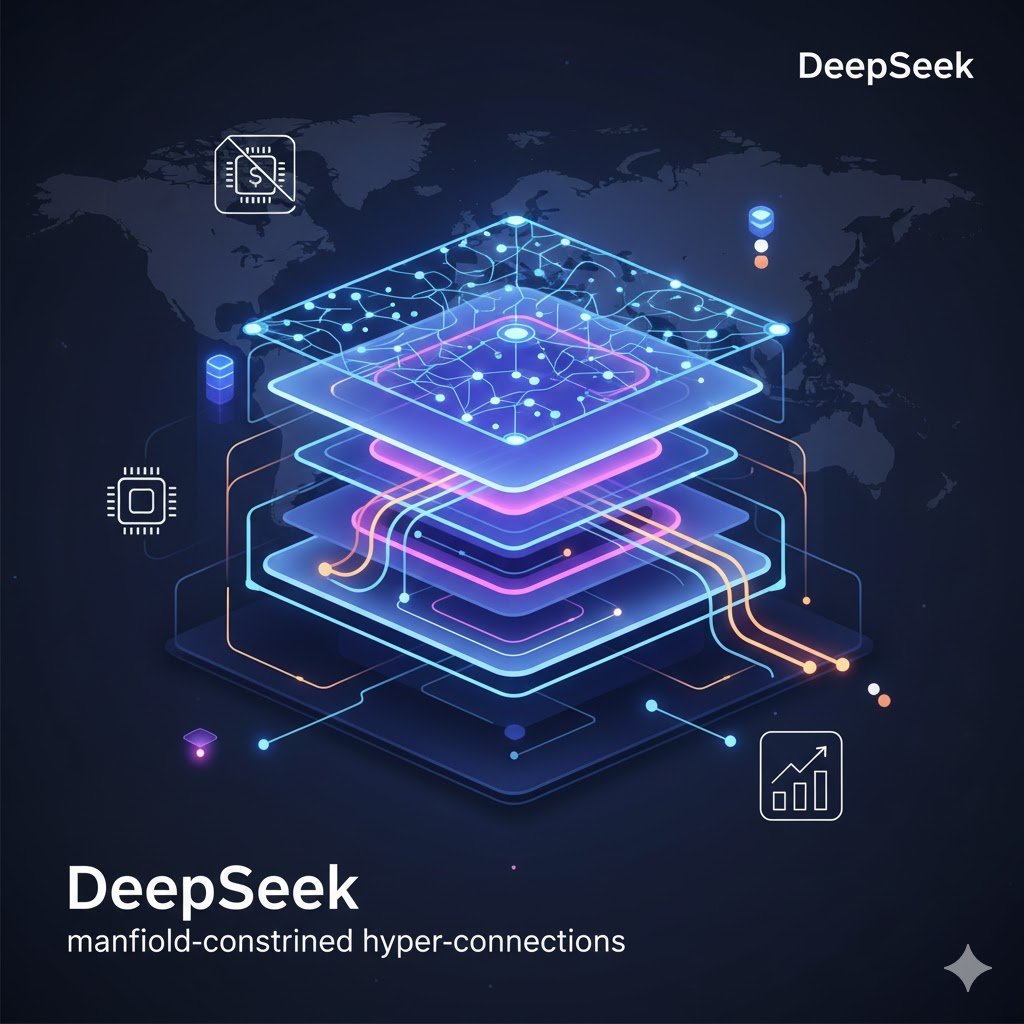
DeepSeek manifold-constrained hyper-connections are a new design for training large AI models in a cheaper and more stable way. DeepSeek is a Chinese AI start-up that wants to compete with big US AI companies by training powerful models with less computing cost.
This new method is called Manifold-Constrained Hyper-Connections (mHC). In simple words, it changes how information moves inside the AI model so that the model can grow bigger without wasting too much memory or power.
What are DeepSeek manifold-constrained hyper-connections?
In many deep learning models, there are special paths called residual connections that help the model learn better and faster. Hyper-connections are an advanced form of these paths, but older hyper-connection designs could make very large models unstable and more expensive to train.
DeepSeek manifold-constrained hyper-connections try to fix this problem. The idea is to control these hyper-connections on a manifold, which keeps the helpful “identity” behavior while still allowing the model to learn rich patterns. This balance makes training large models smoother and safer.
Why DeepSeek manifold-constrained hyper-connections matter
The DeepSeek team tested manifold-constrained hyper-connections on models with 3 billion, 9 billion, and 27 billion parameters. They found that the method scaled well and did not add a big extra computational burden, which means it did not suddenly make training very heavy or slow.
This has three main benefits:
- Lower training cost: Training large models usually needs expensive hardware and a lot of energy, but mHC is designed to reduce memory and compute overhead.
- More stable large models: By bringing back identity-like behavior inside hyper-connections, mHC helps large models train without breaking or diverging.
- Better long-term scaling: Since DeepSeek manifold-constrained hyper-connections work from 3B up to 27B parameters, they can support future, even larger models.
For DeepSeek, this is very important because it allows the company to keep up with richer US rivals using smart engineering instead of only buying more GPUs.
How DeepSeek mHC improves older hyper-connections
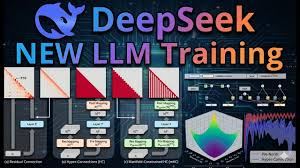
Older hyper-connection designs tried to increase model power by widening the residual streams and adding extra learnable parts, but they often broke the simple identity property and raised memory use. This made extremely large models harder to train in a stable way.
DeepSeek manifold-constrained hyper-connections improve this by:
- Using manifold constraints: The residual space is controlled on a manifold so the model can still act like an identity when needed, while learning complex features when helpful.
- Caring about hardware limits: The design focuses on keeping memory access and compute patterns friendly to real hardware, so the method is practical at scale.
- Working as a general framework: mHC is not just for one special model type; it can be used as a general upgrade to hyper-connections in many large language models.
Because of these changes, experiments show better performance and scalability compared to conventional hyper-connections.
What this means for the future of DeepSeek and AI
This paper is an early signal of where DeepSeek is going in 2026. The company is known for efficient engineering, and DeepSeek manifold-constrained hyper-connections fit this story of doing more with less.
- Future DeepSeek models: Many experts expect that the next big DeepSeek model will use manifold-constrained hyper-connections to handle long context and complex tasks more efficiently.
- More open research: DeepSeek publishing this work adds to the open and collaborative trend among Chinese AI companies, which helps the global AI community learn and improve faster.
- Global pressure: If DeepSeek can train strong models at lower cost with mHC, other AI labs may need to rethink their own architectures and focus more on efficiency, not just size.
Conclusion:
DeepSeek’s Manifold-Constrained Hyper-Connections show a clear shift in AI towards smarter, more efficient training instead of just bigger models. By making large models cheaper and more stable to train, DeepSeek’s approach could shape how future AI systems are designed and push the whole industry to focus on efficiency and practical performance.