5 Hidden Warnings: The Most Dangerous Side Effect of AI On Human Meaning
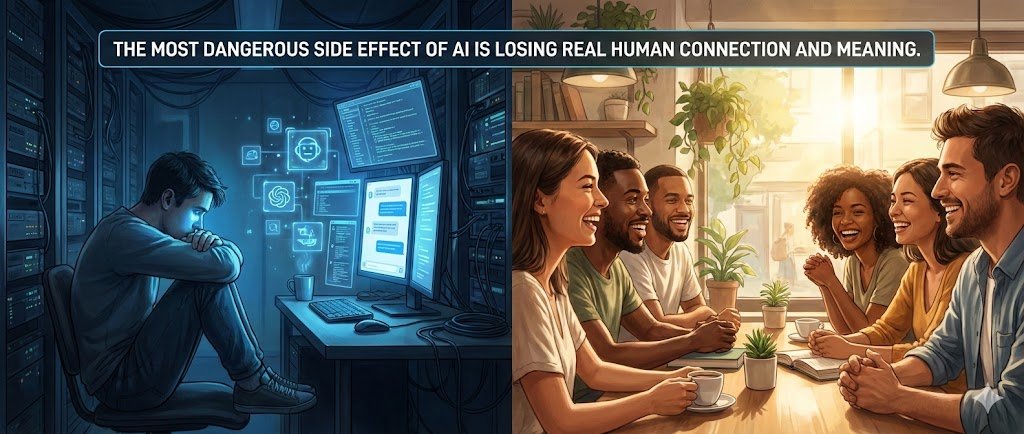
The most dangerous side effect of AI may not be robots taking over jobs but people slowly losing meaning in their lives. Many thinkers are realising that the deepest risk of AI is not only economic, it is emotional and social. When screens, algorithms and AI companions replace real people, many humans can feel less known, less needed and more alone, even if they are always “online”.
Psychiatrist Viktor Frankl, a survivor of Nazi camps and author of Man’s Search for Meaning, showed that people can survive almost anything if they believe their life still has meaning. He believed meaning comes mainly from taking responsibility for others, not just from happiness, comfort or career success. The most dangerous side effect of AI appears when these systems quietly cut us off from the relationships and responsibilities that give us meaning.
How AI Attacks Our Systems Of Meaning
For most of modern history, people found meaning from three simple systems: work, family and local community. We were teachers, shopkeepers, parents, neighbours and members of religious and civic groups where people noticed us and depended on us. These roles made us feel that we mattered because our absence would be felt and our presence helped someone else.
Today, many of these meaning systems are getting weaker at the same time that digital and AI systems are growing fast. Fewer people attend religious services, fewer join long‑term communities and more daily activity is moving onto screens and platforms. At the same time, AI tools and synthetic companions make it easy to spend hours in personalised digital worlds without any deep, two‑way human bonds.
The Most Dangerous Side Effect Of AI: People No Longer Feeling Needed
The most dangerous side effect of AI shows up when people cannot honestly answer one simple question: “Who needs me?” When machines do more work, when content is infinite and when AI companions give synthetic attention, fewer people feel truly necessary to anyone. A person can be constantly entertained and still feel quietly irrelevant.
Frankl noticed that despair often appears when a person feels no one truly needs them. Many people who lost jobs fell into deep depression, but when they began to serve others as volunteers in hospitals or local organisations, their mood and hope often returned. The job itself was not the real source of meaning; it was simply a place where they felt useful to other people.

Being Known × Being Needed: A Simple Meaning Formula
The article the most dangerous side effect of AI suggests a simple formula for modern meaning: Meaning = Being Known × Being Needed. Being known means that real people recognise you, understand you and would notice if you stopped showing up. Being needed means your presence or help makes a real difference to those specific people.
The multiplication is important. If you are known but not needed, you are mostly entertainment or background noise. If you are needed but not known, you are just a tool or a replaceable service. Real meaning grows when you are both known and needed at the same time, which happens most naturally in real relationships, not in algorithmic feeds.
How AI Weakens Being Known And Being Needed
The most dangerous side effect of AI is that it pulls attention away from the human spaces where we are known and needed and pushes it into synthetic spaces where we are mostly measured and monetised. Social media, recommendation engines and AI companions are designed to maximise engagement, not to build deep, mutual relationships. People feel “seen” by systems but not truly seen by other humans.
Research shows that AI and digital platforms can make people feel heard in the short term, but they still feel more deeply heard and valued when they know a response comes from another human. As AI becomes more present in chat, support and companionship, there is a danger that people mistake constant interaction for genuine connection. The most dangerous side effect of AI appears when this confusion leads to a slow erosion of human identity, purpose and belonging.
The Social And Demographic Fallout Of The AI Meaning Crisis
If the most dangerous side effect of AI is lost meaning, then social and demographic problems may follow. Data already shows falling religious participation, rising time on social media and digital video, and lower marriage and fertility rates in many countries. More people spend more hours alone with devices, even when other people are physically nearby.
The article warns that if this continues, many people will reach middle age and later life having spent very little time in deep, mutual relationships. At that point, they may feel both isolated and unnecessary, which can lead to despair, mental health problems and a weaker social fabric. In this way, the most dangerous side effect of AI is not just a personal meaning crisis but also a social and demographic crisis.
Building Meaning In The Age Of AI
If the most dangerous side effect of AI is that it quietly steals our sense of meaning, then the answer is not to reject all AI but to use it differently. Frankl’s insight suggests that people and creators should design their lives around relationships where they are both known and needed. In a world where machines can produce most content and automate many tasks, the rare and valuable asset becomes human relationship.
For creators, entrepreneurs and leaders, this means focusing less on reaching everyone and more on serving a smaller group very deeply. A person who is truly known by a tight community and genuinely useful to them may be protected from both technological disruption and the quiet erosion of purpose. The most dangerous side effect of AI can be reduced when we actively invest in communities, families, local groups and audiences where our real presence still matters.