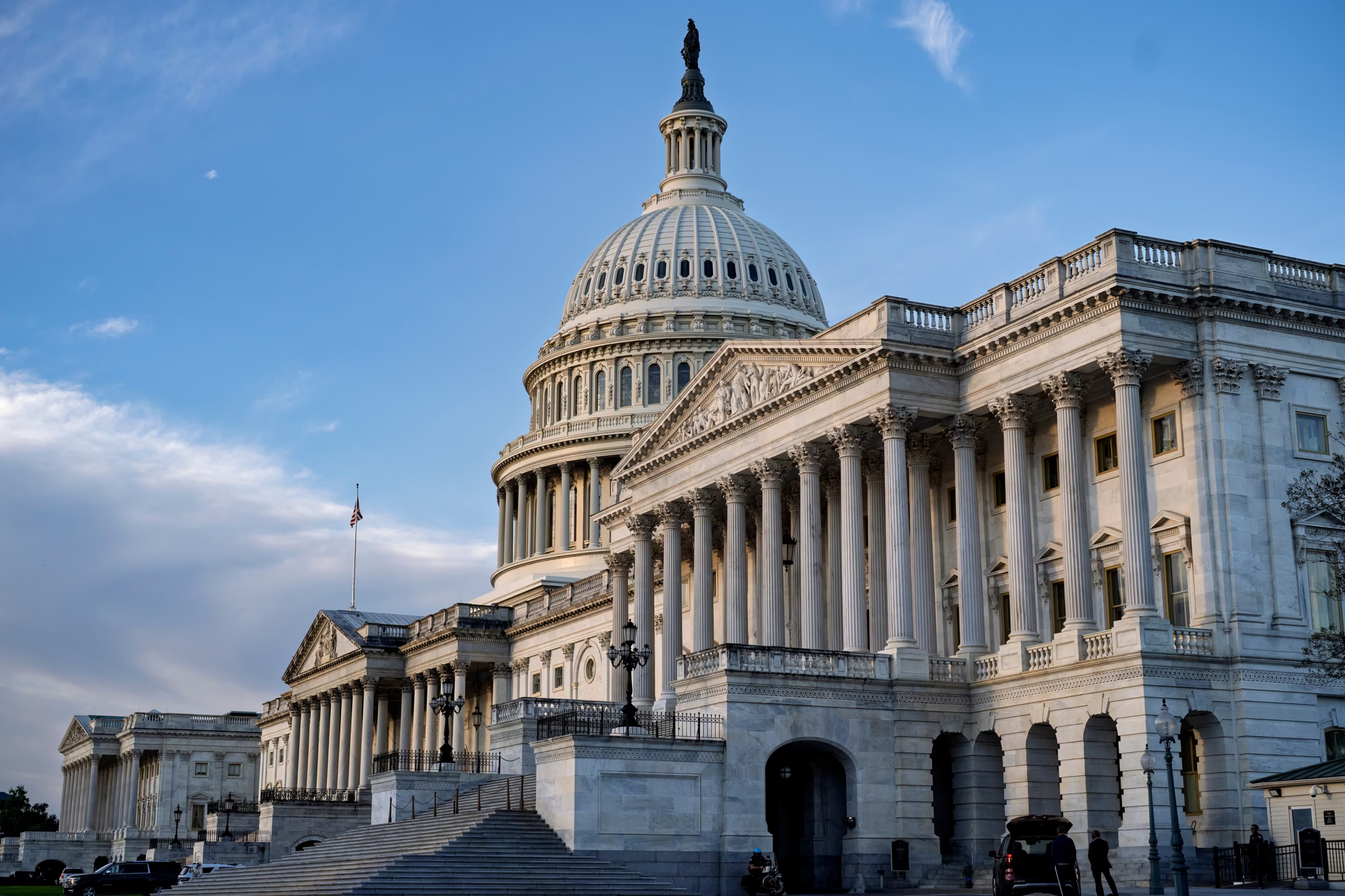
What is in the 2026 U.S. defense bill?
The 2026 U.S. defense bill—formally the National Defense Authorization Act (NDAA)—authorizes roughly $900–901 billion in military spending for fiscal year 2026, one of the largest defense packages in U.S. history. The measure passed both the House and Senate with bipartisan majorities and backs much of President Trump’s national security agenda while still reflecting some congressional checks.
Lawmakers say the bill modernizes the armed forces, accelerates new technologies, and cuts certain older weapons systems and Pentagon bureaucracy. At the same time, it embeds sharp political choices on culture‑war issues, climate spending, and how aggressively to support partners such as Ukraine and Taiwan.
Military pay and workforce changes
One of the most visible elements of the 2026 U.S. defense bill is a 3.8 percent pay raise for U.S. service members, meant to help recruitment and retention in a tight labor market and amid higher living costs. The bill also trims some civilian and climate‑related Pentagon initiatives, arguing that funds should be redirected to core war‑fighting needs.
On social policy, the bill shuts down many diversity, equity, and inclusion (DEI) offices and training programs inside the Department of Defense, eliminating the chief diversity officer role and similar structures. It further prohibits transgender women from competing in women’s athletic programs at U.S. military service academies, a move criticized by LGBTQ+ advocates but backed by conservative lawmakers who argue the military should focus on readiness.

Europe and Ukraine: Funding and troop levels
For Europe and Ukraine, the 2026 U.S. defense bill confirms that Washington is not pulling back from NATO despite rhetoric about deprioritizing the continent. The law sets aside $400 million per year for Ukraine’s security assistance over the next two fiscal years, helping Kyiv continue to defend itself against Russia.
The bill also bars the Pentagon from cutting U.S. troop levels in Europe below 76,000 without consulting Congress and NATO, effectively freezing forward deployments near current levels. It renews security cooperation with the Baltic states and underlines that withdrawing forces while Russia continues operations in Ukraine and hybrid pressure in Europe would be strategically “foolish,” in the words of one analyst.
China, Taiwan, and the Indo-Pacific focus
On China, the 2026 U.S. defense bill moves beyond traditional military spending into economic security. It creates a framework to screen outbound U.S. investment in sensitive technologies in China, requiring notifications to the Treasury Department and empowering officials to block some deals.
The bill embeds the “Biosecure Act,” which bars select Chinese biotech companies from receiving U.S. federal funding, reflecting concern about supply‑chain and data risks. At the same time, it fully funds the Taiwan Security Cooperation Initiative at about $1 billion, authorizes continued U.S. training for Taiwanese forces, and pushes joint work on drone and anti‑drone systems to deter a potential Chinese attack.
Middle East, Syria sanctions, and war powers
In the Middle East, the 2026 U.S. defense bill takes several controversial steps. It removes certain congressional sanctions imposed on Syria in 2019, intended to clear the way for reconstruction after the ouster of former President Bashar al‑Assad, even as critics warn this may reduce leverage over Damascus.
The legislation also repeals older authorizations for the use of military force that date back to the Persian Gulf War and the 2003 Iraq War, moves that could limit future presidents’ ability to launch operations under decades‑old mandates. Supporters say this restores Congress’s constitutional role over war powers; opponents worry it could complicate responses to terrorism or sudden crises.

Latin America, the border, and other regional moves
On Latin America and the U.S.-Mexico border, the 2026 U.S. defense bill authorizes the deployment of active‑duty troops to help secure the frontier, aligning with Trump’s tougher migration and counter‑narcotics posture. It also threatens to cut Defense Secretary Pete Hegseth’s travel budget if the Pentagon does not hand over full, unedited videos of controversial maritime operations to Congress, signaling lawmakers’ push for greater transparency.
Elsewhere, the bill supports Indo‑Pacific allies beyond Taiwan by permitting new security assistance to the Philippines, among others, as part of a wider effort to contest Chinese influence and secure critical sea lanes. It also aims to strengthen U.S. shipbuilding, expand the maritime industrial base, and speed up space and high‑tech capabilities, partly by cutting roughly $20 billion in older or redundant programs.
Why the 2026 U.S. defense bill matters globally
The 2026 U.S. defense bill signals that, despite domestic debates, Washington is doubling down on a high‑spending, forward‑deployed defense posture that confronts Russia in Europe, deters China in the Indo‑Pacific, and keeps a strong footprint in the Middle East. At the same time, it injects U.S. culture‑war issues into military law and tightens economic controls on Beijing, blurring the lines between classic defense policy and broader ideological and geoeconomic competition.
For allies and rivals, the package is a concrete guide to where U.S. priorities are headed through 2026: sustained support for Ukraine and Taiwan, skepticism toward China, continued engagement in NATO, and a willingness to use the military on the southern border. How effectively these funds are spent—and how long Congress sustains such high levels of defense spending—will help shape the global balance of power over the coming years.